
Extension Foundation Online Campus
Search results: 454
Este curso en línea está dirigido a proveedores de
cuidado infantil. Esta curso que dura 30 minutos es una manera divertida
e interactiva de conocer las últimas recomendaciones para niños sobre
bebidas saludables y ayudar a los proveedores de cuidado infantil a
cumplir con los requisitos de la Ley de Bebidas Saludables en el Cuidado
Infantil de California (AB 2084). Este curso que dura 30 minutos,
incluye videos, exámenes rápidos y actividades sobre temas como los
tipos de leche y jugos que se deben servir, el consumo seguro de agua
potable y como usar la información nutrimental de la etiqueta de los
alimentos. El proveedor recibirá un certificado de capacitación al
completar el curso.
El curso es gratis para proveedores de cuidado infantil en California y tiene un costo de $15 para proveedores de cuidado infantil fuera de California.
Si desea comprar este curso, haga clic en el siguiente botón:
- Teacher: Danielle Lee
- Teacher: Steve Pritchard
- Teacher: Troy Walz
Beginning Horseman: 4-H Level 1 is a course for youth 8 to 18 years old
Youth will learn correct and safe handling and riding principles for the beginner horseman.
For more information contact: Lena Luck at University of Nebraska-Lincoln, email address at lena.luck@unl.edu
- Extension Horse Specialist: Lena Luck
Bluebonnet Feeds Equine Nutrition Course is offered from the HorseQuest CoP for Bluebonnet Feed dealers and clients to learn the basics of equine nutrition.
Cost = $50 for 30 days
For more information please contact Kathy Anderson, University of Nebraska-Lincoln, at kanderson1@unl.edu.
Click this button to enroll in this course:
- Teacher: Kathy Anderson
- Teacher: Colleen Brady
- Teacher: Kris Hiney
The City of Bozeman Advisory Board Member Training is intended for the City Advisory Board Members of Bozeman, Montana. This is a self directed course, which should take less than one hour to complete. This course is intended to educate employees and public officials in best practices and legal requirements. It details specific ethical requirements and provides guidance on obtaining information and filing complaints. For detailed instructions on how to login and enroll in this course, take a few minutes and read through the Enrollment Instructions & Helpful Tips document.
For questions or concerns regarding this course, contact Brenda Sweeney, Deputy City Clerk, at (406) 582-2320 or bsweeney@bozeman.net.
- Teacher: Ashley Kent
- Teacher: Lydia Maunz
Students will learn skills to prepare them for post-secondary opportunities. In the 10th grade course, students will learn about time management, study skills, avoiding procrastination, and how to give a presentation.
- Teacher: Mindy Aragon
- Teacher: Leah Haxton
Students will learn skills to prepare them for post-secondary opportunities. In the 11th grade course, students will learn about scholarships and financial aid, resumes and applications, interviews, and post-secondary options.
- Teacher: Mindy Aragon
- Teacher: Leah Haxton
Students will learn skills to prepare them for post-secondary opportunities. In the 12th grade course, students will learn about college visits and job shadowing, money management, professionalism, and civic engagement.
- Teacher: Mindy Aragon
- Teacher: Leah Haxton
This 3-part series begins with the DiSC© Workplace assessment* where participants learn about their preferred work styles and environment. We discuss why this self-awareness is critical to being an effective leader/manager and explore some strategies for anticipating what future employees might be looking for in a manager.
Session 2 dives into organizational culture as it shows up on your farm and why being transparent about the culture you are striving for matters in building a farm team. We will spend time assessing your current culture and exploring strategies to either amplify or change it. We'll share tips on how you can anticipate someone's work style and preferences based on some very common observations.
Session 3 will be an interactive look at how, why and when conflict arises in work environments. We explore strategies to address the role of the manager when there is conflict within the work team, how different DiSC© profiles approach conflict, how to model productive conflict, and how to move beyond conflict and emerge as a stronger team.
These are interactive sessions, and your participation will be critical to our collective learning. Resources will be provided in advance and participants should plan time to review the materials prior to each session. Participants will leave the series with an action plan designed to get your growing season off to a successful start.
- Teacher: Beth Holtzman
- Teacher: Mary Peabody


About the Course:
This course is for program directors, coordinators, staff or anyone directly involved in working with volunteers.
Upon completion of this course, learners should be able to:
- Describe the benefits volunteers provide to programs and organizations
- Identify the roles and responsibilities of those involved in working with volunteers
- Identify the characteristics of an effective volunteer program
- Use the 7-step ISOTURE model to help build volunteer engagement
Along the way, learners will assess their own program, using self-guided activities and resources and develop a volunteer engagement action plan.
|
California Cooperative Extension Staff |
Free with enrollment key (contact your State Coordinator for enrollment key)
|
|
|
|
|
Non-California Users |
|
|
1-4 Seats |
$30 each |
|
5-49 Seats |
$25 each |
|
50-99 Seats |
$20 each |
|
100 or more Seats |
$10 each |
Contact:
For more information or to enroll please contact:
- Gemma Miner, UC ANR, Academic Coordinator for Volunteer Engagement gmminer@ucanr.edu
- UC ANR Course Support, idevelopsupport@ucanr.edu
- ANR Administrator: Zeva Cho
- ANR Administrator: CA 4-H eXtension Tech Support
- ANR Administrator: Scott Mautte
- ANR Administrator: Gemma Miner
- ANR Administrator: Lauren Snowden
This course will help you become a better facilitator in a rapidly evolving virtual world.
Do you find yourself leading more virtual groups? Would you like to improve engagement? Better manage the group’s process and challenges? Have more confidence with the multiple aspects of virtual technology? Adapt proven techniques and tools for a virtual environment? Join us as we explore the emerging best practices of virtual facilitation skills. This course builds on the well-known Strengthening Your Facilitation Skills Level One training. We will build confidence and practice skills in a safe, supportive space.
This course consists of two parts. Each week there will be videos, resource materials and discussion threads for you to engage with prior to our live weekly sessions. These materials will prepare you for for the live, weekly gatherings where we will focus our time on opportunities for deeper discussion of the issues and facilitation practice. It is important that you build time into your schedule for both of these components.
Live Weekly Sessions: (All Times are Eastern)
* April 17, 2024 | 12:00-2:00pm
* April 24, 2024 | 12:00-2:00pm
* May 1, 2024 | 12:00-2:00pm
* May 8, 2024 | 12:00-2:00pm
*May 15, 2024 | 12:00-2:00pm
- Teacher: Suzanne Cagle
- Teacher: Melissa Lee
- Teacher: Michael Polizzotti
- Teacher: Scott Slattery
For experienced facilitators interested in expanding their facilitation skills and implementing this training program as instructors, we are offering a Train the Trainer course concurrent with the core Building Your Virtual Facilitation Skills training.
Train the Trainer participants will be expected to engage in core course content to gain familiarity with the content and structure of the training. In addition to core content, Train the Trainer cohort participants will participate in an additional hour per week of Live content as well as additional content on the course page to build skills in virtual content creation/adaptation and delivery.
Building Your Virtual Facilitation Skills, Train the Trainer participants will receive access to instructor materials including facilitator outlines for each session, course planning materials and web platform participant materials. Cohort sessions will explore implementation best practices, with technical support for adapting and implementing the training in your state.
Live Weekly Sessions, Fall Series: (All Times are Eastern)
Note: The first two hours of each live session are core content. The third hour includes only the train the trainer cohort.
* March 22, 2023 | 12:00-3:00pm
* March 29, 2023 | 12:00-3:00pm
* April 5, 2023 | 12:00-3:00pm
* April 12, 2023 | 12:00-3:00pm
*April 19, 2023 | 12:00-3:00pm
For any questions, please reach out to Sue Cagle at sue.cagle@unh.edu.
****This course is now full for the spring 2023 semester. Please contact the instructor with questions concerning future offerings.****- Teacher: Suzanne Cagle
Welcome to the course!

Course Overview:
The overall program aims to promote mindful practices that lead to improvements in managing one’s own goals, developing a sense of self, time management, stress management, emotional regulation, and mindful eating practices. 4-H Mindful Mechanics can also serve as a training for teens that would like to lead lessons from the companion curriculum, 4-H Mindful Me, through a ‘teens as teachers’ (TAT) approach.
- The course is designed for teens ages 13-18 and adult leaders.
For more Information about this course, please contact:
Anne Iaccopucci, PhD
4-H Healthy Living Academic Coordinator II
University of California, Agriculture and Natural Resources
Email: amiaccopucci@ucanr.edu
- Teacher: Dorina Espinoza
- Teacher: Anne Iaccopucci
Course Overview:
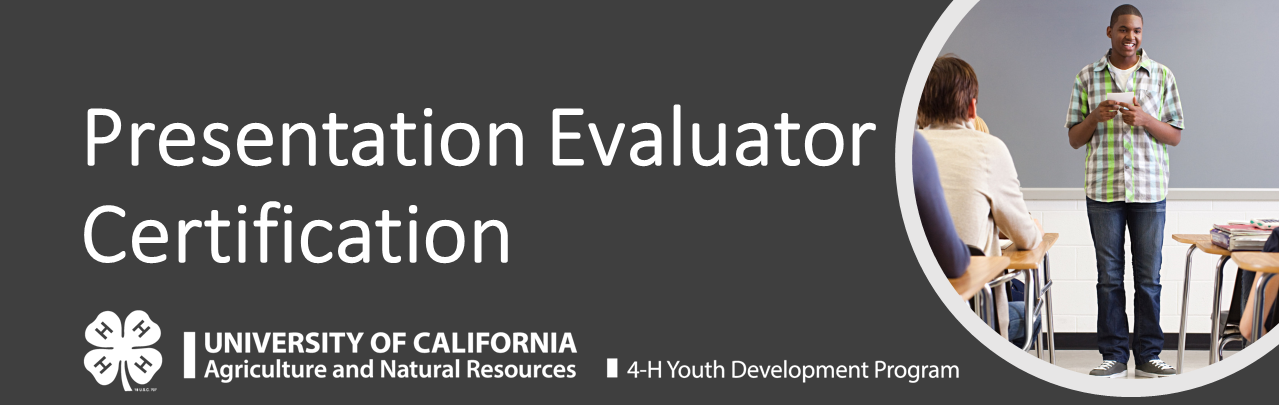
The purpose of the California 4-H Presentation Program is to help youth improve their public speaking abilities. Presentation events are one strategy to reach this goal by allowing youth to practice the knowledge and skills gained and receive constructive feedback on their progress. This requires that evaluations be accurate and consistent.
The Presentation Evaluator Certification is designed to prepare individuals to evaluate California 4-H presentations accurately and consistently. This course consists of two parts:
- Presentation Evaluator Orientation Course which is designed to provide an overview of the presentation program while offering best practices on how to effectively complete a presentation evaluation assessment and provide written feedback.
- Presentation Format Calibration Certifications
which offer individuals an opportunity to
measure their level of evaluation expertise for each presentation format
through a series of calibration exams.
Learners who successfully calibrate each presentation format with a score of 80% or greater will receive an electronic badge, certificate, and are certified to evaluate on that specific presentation format. When all presentation formats have been successfully completed, the individual will earn the "Master 4-H Presentation Evaluator" achievement badge and certificate.
This course is designed for individual participation and not for group settings.
Who Should Attend:
The course is designed for California 4-H volunteers or program partners, ages 16 and up, who
desire to be a presentation evaluator at county, regional, or state
presentation events.
Technical Support
If you are experiencing technical difficulties with any portion of this course, please submit a help ticket at http://bit.ly/4hsupport.
Sections of the course may take longer to load based on individual internet bandwidth and connectivity. Outdated technology such as legacy operating systems or older versions of web browsers may affect access to this course or the quality of this training experience.
- Teacher: Vera M. Bullard
- Teacher: Zeva Cho
- Teacher: CA 4-H eXtension Tech Support
- Teacher: Nicole Marshall-Wheeler
- Teacher: Gemma Miner
Sobre el curso
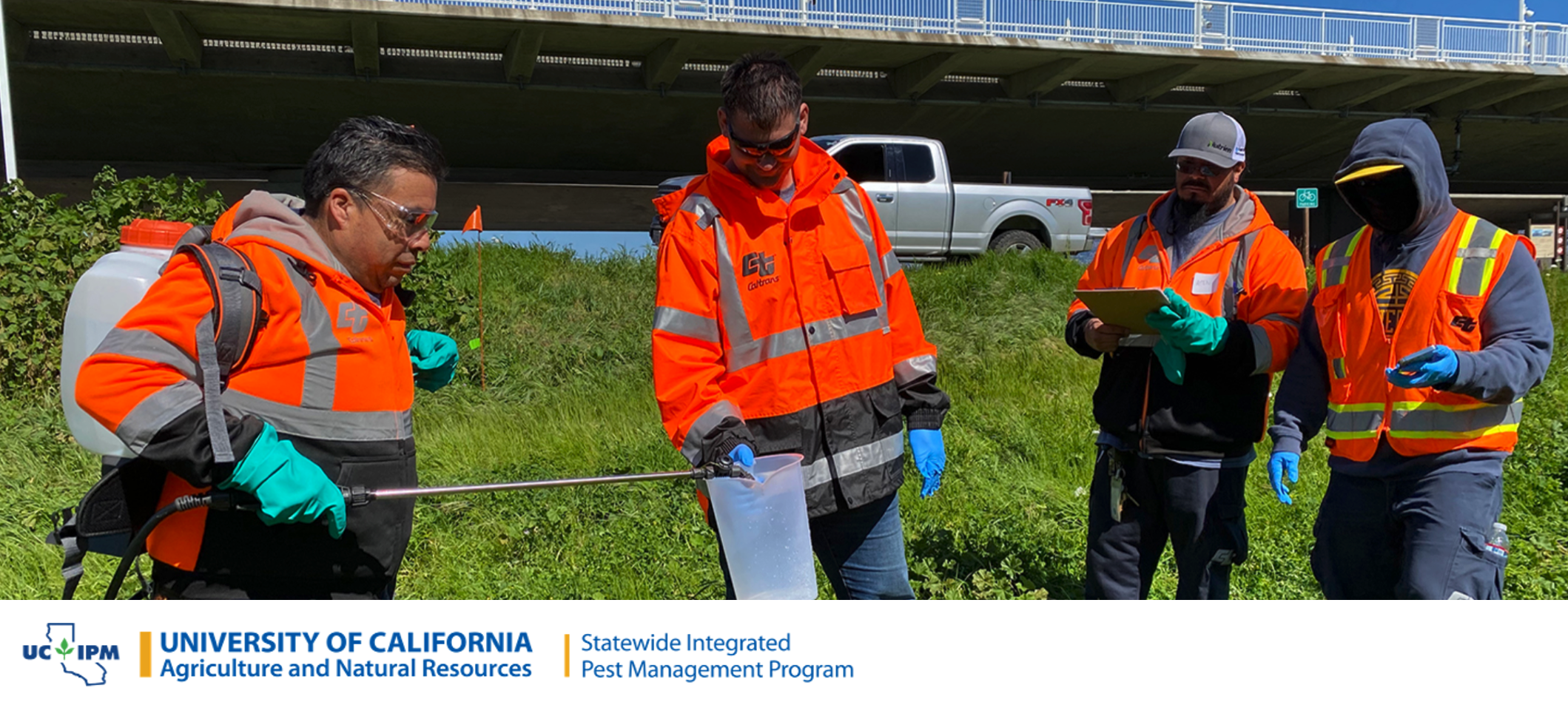
Este curso aborda varios métodos de calibración y tipos de equipos utilizados para gestionar malezas herbáceas y lechosas en muchos de los diferentes ecosistemas de California. El curso está disponible de forma gratuita. Contiene videos, por lo que se requiere un dispositivo que pueda reproducir audio y video.
¿Quién debería inscribirse en este curso?
Cualquier persona que trabaje con equipos de aplicación de herbicidas para el control de malezas lechosas y herbáceas en áreas no agrícolas.
Créditos de Educación Contínua
Departamento de Reglamentación de Pesticidas de California (0.5 hour Laws & Regs and 1.5 hours Other).
Período de inscripción
Este curso debe completarse antes del 30 de diciembre del año en curso. Descargue el certificado inmediatamente después de completar el curso. No podrá recuperar su certificado después del 30 de diciembre.
¿Necesita ayuda?
Para obtener ayuda con el inicio de sesión, la inscripción al curso o el pago, comuníquese con campushelp@extension.org. Para obtener ayuda con el progreso del curso o certificado, comuníquese
con UCIPMcourses@ucanr.edu.
- Technical support: UC IPM Online Training Support
Course overview
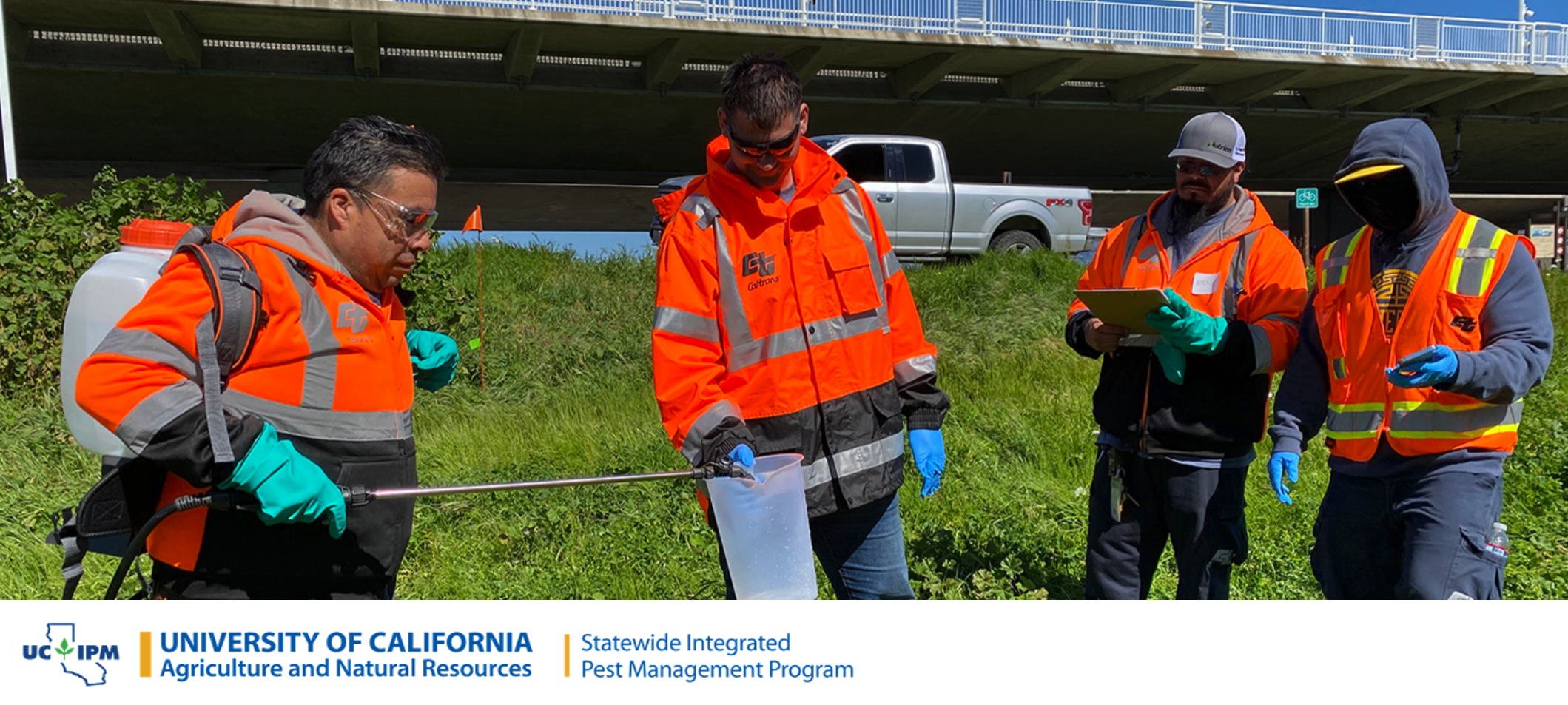
This course covers several calibration methods and various types of equipment used for managing both herbaceous and woody weeds across many of California’s different ecosystems. This course is available for free. The course contains video so it requires a device that can play audio and video.
Who should enroll?
Anyone who works with herbicide application equipment for controlling woody and herbaceous weeds in non-agricultural areas.
Continuing Education Units
California Department of Pesticide Regulation (0.5 hour Laws & Regs and 1.5 hours Other).
Enrollment period
This course must be completed by December 30 of the current year. Download the certificate immediately when you complete the course. You will not be able to retrieve your certificate after December 30.
- Technical support: UC IPM Online Training Support




Welcome to the Class of 2026 Initial Training Course to be a Master Composter volunteer. This course is offered by UC Cooperative Extension of Santa Clara County through the Composting Education Program.
This course is designed to enrich your composting knowledge so that you can provide unbiased, science-based information to residents of Santa Clara County. The course will cover topics such as Introduction and History of Composting, SB1383, Compost Life Cycle, Soil Health, Vermicomposting, and Extension Education. We will also have units on the Use of Compost, Community Composting, and Starting a Home Composting System.
By the end of this course, you will 1) have a strong foundation in the fundamentals of composting, 2) know how to use science-based information to answer composting questions, 3) have an understanding of how to engage and educate members of the Santa Clara County community, and 4) be familiar with the structure and function of the Composting Education program of Santa Clara County. With these skills and knowledge, you will be equipped to share science-based information on home composting with the public through the many organized volunteer activities the Composting Education Program and community partners have to offer.
Each class is taught by a different guest instructor. Instructors include University of California academics, Industry Professionals, Staff from Community Organizations, as well as Master Composter Volunteers.
- Teacher: Michael Cohen
- Teacher: Sarah Farley
- Teacher: Jenel Vincze
- Teacher: Lauren von Aspen
This is a restricted course and available only for enrolled Child Development Associate Students.
- Teacher: Savannah Castanon
- Teacher: Janelle Jamero
- Teacher: Cathryn Peshlakai
- Teacher: Erin Skaggs
- Teacher: Rebecca Vizina
- Teacher: Lisa Whipple
- Teacher: Sarah Wright
- Teacher: Marybel Arreguin-Lopez
- Teacher: Desiree Cabacar
- Teacher: Savannah Castanon
- Teacher: Maria Jake
- Teacher: Janelle Jamero
- Teacher: Cathryn Peshlakai
- Teacher: Chelsie Shurtleff
- Teacher: Erin Skaggs
- Teacher: Shanell Townsend
- Teacher: Lisa Whipple
- Teacher: Sarah Wright


- Teacher: Marybel Arreguin-Lopez
- Teacher: Maria Jake
- Teacher: Stephanie May
- Teacher: Cathryn Peshlakai
- Teacher: Lisa Whipple
- Teacher: Sarah Wright

This is a restricted course and available only for enrolled CDA Students.

- Teacher: Marybel Arreguin-Lopez
- Teacher: Maria Jake
- Teacher: Stephanie May
- Teacher: Cathryn Peshlakai
- Teacher: Lisa Whipple
- Teacher: Sarah Wright

Este es un curso restringido y disponible solo para estudiantes inscritos en CDA.

- Teacher: Marybel Arreguin-Lopez
- Teacher: Maria Jake
- Teacher: Stephanie May
- Teacher: Cathryn Peshlakai
- Teacher: Lisa Whipple
- Teacher: Sarah Wright

This is a restricted course and available only for enrolled CDA Students.

- Teacher: Marybel Arreguin-Lopez
- Teacher: Maria Jake
- Teacher: Stephanie May
- Teacher: Cathryn Peshlakai
- Teacher: Lisa Whipple
- Teacher: Sarah Wright

This is a restricted course and available only for enrolled CDA Students.

- Teacher: Marybel Arreguin-Lopez
- Teacher: Maria Jake
- Teacher: Stephanie May
- Teacher: Cathryn Peshlakai
- Teacher: Lisa Whipple
- Teacher: Sarah Wright

This is a restricted course and available only for enrolled Child Care Excellence Academy Students.

- Teacher: Marybel Arreguin-Lopez
- Teacher: Maria Jake
- Teacher: Stephanie May
- Teacher: Cathryn Peshlakai
- Teacher: Lisa Whipple
- Teacher: Sarah Wright

This is a restricted course and available only for enrolled CDA Students. 
- Teacher: Marybel Arreguin-Lopez
- Teacher: Savannah Castanon
- Teacher: Maria Jake
- Teacher: Stephanie May
- Teacher: Cathryn Peshlakai
- Teacher: Lisa Whipple
- Teacher: Sarah Wright

This is a restricted course and available only for enrolled CDA Students. 
- Teacher: Marybel Arreguin-Lopez
- Teacher: Maria Jake
- Teacher: Stephanie May
- Teacher: Cathryn Peshlakai
- Teacher: Lisa Whipple
- Teacher: Sarah Wright
The purpose of the CFCWR Intern Training program is to provide participants with an interdisciplinary perspective of food equity in the United States and increase their understanding and competency about this issue. This program was developed and is administered by the USDA-funded Center for Food Conservation and Waste Reduction.
Curriculum Outline:
The training program is a weekly online synchronous class (~1 1/2 to 2 hours) for 9 weeks plus a post-training research project. The 9-weeks include an orientation in week 1 and recap in week 9 with the following topics weeks 2 to 7:
1. Sustainable U.S. Food System
2. Food security and social determinants of health
3. Nutrition, Disease, and Health Disparities
4. Food Equity
5. Food Waste and Conservation
6. Community organizations involved in food equity
7. Policies related to food equity
Additionally, participants will engage in a post-training research project related to household food waste or other food equity topic to earn their certificate.
Expectations:
Participants will be expected to complete weekly pre-readings, participate in Q&A during the Zoom meeting based on the weekly topics, complete a weekly reflection based on the week's topic, complete pre- and post-program and weekly session surveys,
Prerequisites:
Participants must apply to the program and be selected by the program's administrator to participate. to apply, please contact Karen Byrd, at ksbyrd@purdue.edu .
- Instructor: Karen Byrd
- Instructor: Brenna Ellison
The purpose of the CFCWR Intern Training program is to provide participants with an interdisciplinary perspective of food equity in the United States and increase their understanding and competency about this issue. This program was developed and is administered by the USDA-funded Center for Food Conservation and Waste Reduction.
Curriculum Outline:
The training program is a weekly online synchronous class (~1 1/2 to 2 hours) for 9 weeks plus a post-training research project. The 9-weeks include an orientation in week 1 and recap in week 9 with the following topics weeks 2 to 7:
1. Sustainable U.S. Food System
2. Food security and social determinants of health
3. Nutrition, Disease, and Health Disparities
4. Citizen Science
5. Food Waste and Conservation
6. Community organizations involved in food equity
7. Policies related to food equity
Additionally, participants will engage in a post-training research project related to household food waste or other food equity topic to earn their certificate.
Expectations:
Participants will be expected to complete weekly pre-readings, participate in Q&A during the Zoom meeting based on the weekly topics, complete a weekly reflection based on the week's topic, complete pre- and post-program and weekly session surveys,
Prerequisites:
Participants must apply to the program and be selected by the program's administrator to participate. to apply, please contact Karen Byrd, at ksbyrd@purdue.edu .
- Teacher: Karen Byrd
- Teacher: Brenna Ellison
- Teacher: Megan Berthiaume