
Extension Foundation Online Campus
Resultados de la búsqueda: 540
Course Name: AB012-Financial Analysis
This course builds on the previous module’s financial overview of budgets and statements. Using examples, this class explains in greater detail how to create and analyze a partial budget and an enterprise budget using tools like sensitivity analysis and break-even analyses. MyFi Assist is also re-introduced. This tool can be used to find monthly payments to be used in a partial budget or an enterprise budget, which will allow participants to find break-even points or complete sensitivity analyses. Participants should understand that all financial options should be considered on paper to determine the outcomes that are good, bad, and ugly. Once these are known, it becomes possible to plan for future financial success. 1. Sensitivity analysis 2. Break-even analysis 3. Partial budgeting Questions? Email Trent Teegerstrom at tteegers@ag.arizona.edu.The course contains video so it requires a computer that can play audio and video.
- Teacher: Vaeaps Box
- Teacher: Jody Dean
- Teacher: Don Dinwiddie
- Teacher: Robert Masson
Course Name: AB013-Introduction to American Indian Land Tenure Act
This course covers first how American Indian reservations were established, beginning with the Doctrine of Discovery, to Manifest Destiny and the creation of the Office of Indian Affairs, through the evolution of federal policies that have created the reservations that we know today. The second section of the module covers the difficulties of navigating the uniqueness of each reservation. How the reservation was established and whether or not it was impacted by the Dawes Act of 1887 will determine land tenure on a given reservation. American Indian trust land is held in a "trust status" by the US government; in the case of allotments, fractionation occurs, resulting in hundreds of owners on a single parcel of land. Water rights are also brought up as a contentious issue on reservations, and the use of Indian trust land as collateral is difficult. This class shines light on the laws and legislation that have created social economic hardship for reservations and Native Americans. 1. Federal policy eras 2. Tribal governance and the federal relationship 3. Tribal sovereignty 4. General Allotment Act, 1887 5. Fractionation 6. Trust to fee conversion 7. Water rights on reservations Questions? Email Trent Teegerstrom at tteegers@ag.arizona.edu.The course contains video so it requires a computer that can play audio and video.
- Teacher: Vaeaps Box
- Teacher: Jody Dean
- Teacher: Don Dinwiddie
- Teacher: Robert Masson
Course Name: AB014-Ownership, Liability, and Risk
This course covers different business structures and the advantages and disadvantages of each. For example, a sole proprietorship (the most common type of business structure) is owned and operated by a single individual. Sole proprietorship has the most flexibility of the business structures, but this flexibility comes with a price—unlimited liability. This class also covers risk and risk management. Areas of risk can include production, financial, price, institutional, or human. This module will teach participants how to evaluate the level of risk in their businesses or farms and create plans for corrective measures to avoid or minimize risk. Identifying and managing risk in the early stages of the planning phase is important. 1. Business structures and the pros and cons of each 2. Risk management 3. Tools for managing risk 4. Analyzing on farm risk 5. Food safety issues 6. Disaster preparedness Questions? Email Trent Teegerstrom at tteegers@ag.arizona.edu.
The course contains video so it requires a computer that can play audio and video.
- Teacher: Vaeaps Box
- Teacher: Jody Dean
- Teacher: Don Dinwiddie
- Teacher: Robert Masson
Course Name: AB015-Tax Issues for Farmers and Ranchers
This course introduces common tax filing issues for owners of small businesses or farms. The information presented in this module comes from the Ruraltax.org website, which contains a variety of small farm tax examples that could be used to supplement the presentation. This module briefly touches of individual tribal tax and deferred tax issues. This module is not meant to be a comprehensive look at taxes and tax issues; rather, it is meant to help participants become more aware of the types of tax issues that exist. 1. Basic tax forms 2. Schedule F 3. Self-employment taxes 4. Hobby loss rules 5. Form 1099 6. Individual tribal taxes 7. Section 179 8. Depreciation and estate taxes Questions? Contact Trent Teegerstrom at tteegers@ag.arizona.edu.The course contains video so it requires a computer that can play audio and video.
- Teacher: Vaeaps Box
- Teacher: Jody Dean
- Teacher: Don Dinwiddie
- Teacher: Robert Masson


- Teacher: Lyra Bach
- Teacher: Cathryn Peshlakai
- Teacher: Lisa Whipple
- Teacher: Sarah Wright
- Teacher: Geraldine Wynn
Veterans Agricultural Education and Apprenticeship Program in the Southwest
Course Name: Ag Chem and Water Quality
Presented by: Dr. Karl Wyant
Course Overview:Dr. Karl Wyant, Director of Agronomy with Nutrien will talk about how spray water quality can negatively impact Ag chemical performance. He will also explain to us how to use a water quality sample to predict future interactions or explain current results, when and how to sample spray water and how to understand a water quality sample report. Dr. Wyant will break down a spray water quality report and explain the effects it has on the chemicals it is mixed with.
The course contains video so it requires a computer that can play audio and video.
Contact and technical support: Robert Masson, masson@arizona.edu.
- Teacher: Vaeaps Box
- Teacher: Jody Dean
- Teacher: Don Dinwiddie
- Teacher: Robert Masson
This course provides the skills and knowledge needed for agricultural and livestock producers to perform essential work safely in an area that may be subject to an evacuation order during an emergency incident. It provides foundational information to aid in decision-making. Topics include training on incident response, fire terminology and symbols, fire behavior, fuel, topography, weather, hazards, safety, risk management, entrapment avoidance, and disaster preparedness. This training is designed to satisfy the curriculum requirements for livestock (and plant agriculture if applicable) producers eligible for livestock pass programs described in Section 2350 of the Food and Agricultural Code. The curriculum is intended to provide for the initial certification as well as the continuing education or recertification of livestock producers eligible for livestock pass programs and expands on the curriculum developed by the state fire marshal to meet. Please check with your county program to determine if an online training, and specifically this training will satisfy the requirements of your local county livestock or ag pass program policies.
- Teacher: Randi Black
- Teacher: Tori Norville

Pesticide product labeling is the
main method of communication between a pesticide manufacturer and pesticide
users. The information printed on or attached to the pesticide container is the
label. Labeling includes the label plus all other information you
receive from the manufacturer about the product when you buy it.
Credits for this course are currently available for New Hampshire, Maine, Vermont, Massachusetts, Connecticut, Rhode Island and Pennsylvania.
For more information or to enroll please contact Rachel Maccini, Pesticide Safety Education Program Coordinator, University of New Hampshire.
The fee for this course is $40. To purchase and enroll in it, select the following button:
- Teacher: Rachel Maccini

This course is designed to remind applicators to the severity of pesticide poisoning and how this poisoning depends on the pesticide's chemical makeup and formulation, its path into the body, the amount that enters the body, and the length of exposure. Wearing PPE can greatly reduce the potential for dermal, inhalation, eye, and oral exposure, and thereby significantly reducing the chances of a pesticide poisoning, but it does not necessarily eliminate it.
Credits for this course are currently available for New Hampshire, Maine, Vermont, Massachusetts, Connecticut, Rhode Island and Pennsylvania.
- Teacher: Rachel Maccini

This class will help guide you in identifying dangerous situations, taking preventative measures to minimize risks, and responding appropriately when an accident occurs. Preparation is key to safeguarding yourself and your employees.
Credits for this course are currently available for New Hampshire, Maine, Vermont, Massachusetts, Connecticut, Rhode Island and Pennsylvania.
The fee for this course is $40. To purchase and enroll in the course, select the following button:
- Teacher: Rachel Maccini

Proper disposal of pesticides and pesticide containers is an important phase of pest management an improperly disposed product can be hazardous to people and the environment. READ THE PRODUCT LABEL for specific disposal information.
Credits for this course are currently available for New Hampshire, Maine, Vermont, Massachusetts, Connecticut, Rhode Island and Pennsylvania.
The fee for this course is $40. To purchase and enroll in the course, click the button below:
- Teacher: Rachel Maccini

This course was designed as an interactive course. It will require you to read through a variety of different pesticide labels and choose the best product to handle a situation provided to you. You will be able to choose any product provided, however when you make a choice that is not the best choice you will be faced with some consequences. It will be important that you read the labels thoroughly and choose the best product.
For more information, please contact Rachel Maccini
- Teacher: Rachel Maccini

Credits for this course are currently available for New Hampshire, Maine, Vermont, Massachusetts, Connecticut, Rhode Island and Pennsylvania.
- Teacher: Rachel Maccini

Pesticide Applicator recertification credits for a variety of subjects including backpack sprayers and the label.
Credits for this course are currently available for New Hampshire, Maine, Vermont, Massachusetts, Connecticut, Rhode Island and Pennsylvania.
For more information or to enroll please contact Rachel Maccini, Pesticide Safety Education Program Coordinator, University of New Hampshire.
- Teacher: Rachel Maccini

By taking this course, students will learn:
The Worker Protection Standard (WPS) is a regulation developed by the United States Environmental Protection Agency (EPA) to protect workers and handlers from the harmful effects of pesticides and their residues. The standard went through some major
revisions in 2015 and this course will reflect those changes.
This course will cover some of the major points of the Worker Protection Standard and what employers need to cover with their employees in order to comply.
Once you've completed this course, you should be able to:
- Define a worker and a handler
- Understand the importance of the WPS
- Know when compliance is necessary
- Identify the basic requirements needed by both a worker and handler to reduce their pesticide exposure
Watch the presentation from beginning to end. There are review questions interspersed to help you review the information. When you feel you are comfortable with the information, take the final assessment below Jeopardy game.
For more information please contact Rachel Maccini, Pesticide Safety Education Program Coordinator, University of New Hampshire, Cooperative Extension.
The fee for the course is $40. To purchase and enroll in the course, click the following button:
- Teacher: Rachel Maccini
This course will prepare you for Idaho State Department of Agriculture pesticide exam Agriculture Crop Pest Control (AC) category. For professional applicators who use or oversee the use of pesticides in the production of agricultural commodities, including grasslands and non-crop agricultural lands.
You will have access to eight online instructional sessions to complete at your own pace. Each session contains an outline to use for enhancing your study and quizzes to evaluate your knowledge.
The fee for this course is $75-one month access. To purchase and enroll in the course, click the following button:
- Teacher: cals ipm
The audience for this course is:
The goal of this curriculum is to build environmental literacy as it relates to agricultural production among future farmers and the educators that work within this field. The objective, scientifically-sound curriculum is for secondary students (career and technical centers, grades 9-12). It goes beyond simply sharing information and providing outreach to require students to problem-solve, think critically, have a systems approach, as budding farmers, and embody environmental stewardship with their management decisions.
By taking this course, students will learn:
Topics include: watersheds, reading the soil, soil management practices, nutrient management planning, precision agricultural technology tools, agricultural and environmental policy, and a case study. Each unit is complete with lectures, activities, scoring rubrics, proficiency standards, and field trips which helps make the curriculum widely accessible and adaptable to agricultural educators and their students. Students will learn practical, responsible agricultural management that minimizes impacts on water resources. Through completing this curriculum, educators can receive industry-recognized credentials from the Vermont Agency of Education (VAOE). We encourage all educators taking part in the implementing the curriculum to provide feedback and send additional resources they may be using to add to this resource library.
For more information or to enroll please contact:
Heather Darby, heather.darby@uvm.edu, Lindsey Ruhl, lindsey.ruhl@uvm.edu, and Catherine Davidson, catherine.davidson@uvm.edu.
- Teacher: Catherine Davidson
- Teacher: Lindsey Ruhl
AgSafety4u 2.0 provides an overview of identification and control of hazards common to farms and agriculturally related rural businesses, focusing on hazards associated with machinery, structures, equipment, animals, chemicals and outdoor environment. Learning objectives for Agricultural Employees, Employers and other rural workers who take the course are to a) Describe principles of hazard identification and control and b) Recognize hazards found on farms and in agriculturally related rural businesses.
Additional information about the course can be found at https://ag-safety.extension.org/agsafety4u-certificate-course/
Course Fee: $10. Click here to purchase and enroll in this course:
For additional information, contact Aaron M. Yoder (aaron.yoder@unmc.edu).
- Teacher: Deana Namuth-Covert
- Teacher: Aaron Yoder
Course Name: AH001-Basics of Agriculture and Horticulture Production
Join Dr. Ursula Schuch for this introductory course into horticulture and agriculture production. If you have follow up questions, feel free to email Dr. Schuch at uschuch@arizona.edu.The course contains video so it requires a computer that can play audio and video.
Contact and technical support: Robert Masson, masson@arizona.edu.
- Teacher: Vaeaps Box
- Teacher: Jody Dean
- Teacher: Don Dinwiddie
- Teacher: Robert Masson
Course Name: AH002-Organic Versus Conventional Food Production
This class will cover definitions of different types of production: • Conventional • Sustainable • Pesticide free • Local • Organic • USDA certified organic Requirements for USDA organic production will be discussed. Questions? Contact Dr. Ursula Schuch at uschuch@arizona.eduThe course contains video so it requires a computer that can play audio and video.
Contact and technical support: Robert Masson, masson@arizona.edu.
- Teacher: Vaeaps Box
- Teacher: Jody Dean
- Teacher: Don Dinwiddie
- Teacher: Robert Masson
Course Name: AH003-Controlled Environment Food Production
Introduction to different types of controlled environment food production. Topics covered will include infrastructure requirements, control of environmental factors, and examples of production using the following systems: • Hydroponic • Aquaponics • Mushroom Cultivation Questions? Contact Dr. Ursula Schuch at uschuch@arizona.edu.
The course contains video so it requires a computer that can play audio and video.
- Teacher: Vaeaps Box
- Teacher: Jody Dean
- Teacher: Don Dinwiddie
- Teacher: Robert Masson
Course Name: AH004-Food Safety
Remember to check in with Dr. Schuch following completing the course at uschuch@u.arizona.edu
The course contains video so it requires a computer that can play audio and video.
- Teacher: Vaeaps Box
- Teacher: Jody Dean
- Teacher: Don Dinwiddie
- Teacher: Robert Masson
Course Name: AH005-Landscape Management
Contact Dr. Ursula Schuch at uschuch@u.arizona.edu with any questions.
The course contains video so it requires a computer that can play audio and video.
- Teacher: Vaeaps Box
- Teacher: Jody Dean
- Teacher: Don Dinwiddie
- Teacher: Robert Masson
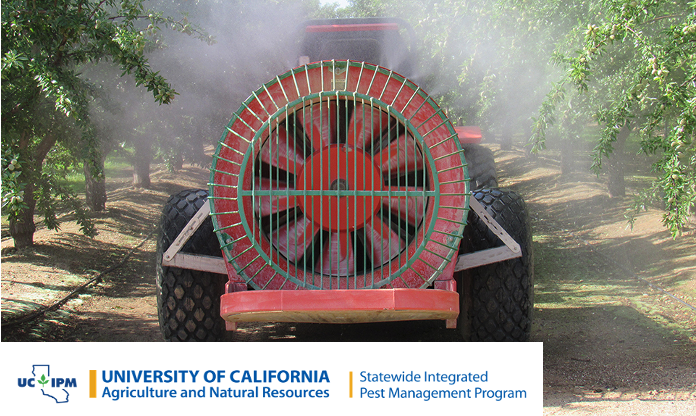

This course provides information on the basic principles of spray calibration, including application rate calculations, describes the components of a sprayer, and takes a look at how droplet size, nozzle type, and weather conditions influence drift and spray coverage. Also covered are conditions for pesticide applications under the 2018 Pesticide Use Near Schoolsites regulation. This course is available for free. The authors of the course are Lynn Wunderlich, UCCE Farm Advisor Amador, Calaveras, El Dorado, and Tuolumne Counties and Dr. Franz Niederholzer, UCCE Farm Advisor Colusa County.
Who should enroll?
Anyone who works with air blast sprayers or is involved with ensuring successful pesticide applications in trees and vines. This includes pesticide handlers, pest control advisers, growers, and supervisors.
Continuing education units
California Department of Pesticide Regulation (1.0 hour Laws & Regulations and 1.5 hours Other) and Certified Crop Adviser (2.0 IPM).
Enrollment period
- For assistance with login, course enrollment, or payment, contact campushelp@extension.org.
- For assistance with progress through the course or certificate, contact UCIPMcourses@ucanr.edu.
- Technical support: UC IPM Online Training Support
In this program, Extension Professionals, local officials, citizen advocates, non-profit groups, government agencies and general public, including those who are interested in the basic concepts of public land use and development regulation and in the best practices of community development and smart growth will learn to make positive land use decisions for their communities regarding zoning regulation, best practices for planning and zoning, and sustainable community planning.
Each units is designed to help students learn the core tasks of being a Planning Official.
In order to offer this online learning opportunity and maintain consistency between the classroom course and the online units, each unit includes content equal to or more than what is provided in the classroom sessions. Each unit is designed to take between 45 minutes to an hour. However, you can stop and restart a unit at your convenience.
For more information contact Daniel Walker at walke422@purdue.edu.
This course is available for a fee of $200 as part of a bundle that includes ACP-Indiana 101, 201, and Comprehensive Exam. To purchase this bundle of courses, click the following button.
- Teacher: Daniel Earl Walker
American Citizen Planner - Indiana 201 is an online course which will provide an in-depth look at land use planning and zoning along with management and ethics case studies and best practices.
For more information contact Daniel Walker at walke422@purdue.edu.
This course is available for a fee of $200 as part of a bundle that includes ACP-Indiana 101, 201, and Comprehensive Exam. To purchase this bundle of courses, click the following button.
- Teacher: Daniel Earl Walker
American Citizen Planner - Indiana Comprehensive Exam is an online exam and certificate course.
For more information contact Daniel Walker at walke422@purdue.edu.
This course is available for a fee of $200 as part of a bundle that includes ACP-Indiana 101, 201, and Comprehensive Exam. To purchase this bundle of courses, click the following button.
- Teacher: Daniel Earl Walker
In this program, Extension Professionals, local officials, citizen advocates, non-profit groups, government agencies and general public, including those who are interested in the basic concepts of public land use and development regulation and in the best practices of community development and smart growth will learn to make positive land use decisions for their communities regarding zoning regulation, best practices for planning and zoning, and sustainable community planning.
Each units is designed to help students learn the core tasks of being a Planning Official.
In order to offer this online learning opportunity and maintain consistency between the classroom course and the online units, each unit includes content equal to or more than what is provided in the classroom sessions. Each unit is designed to take between 45 minutes to an hour. However, you can stop and restart a unit at your convenience.
For more information contact Kara Salazar (salazark@purdue.edu).
The fee for this course $100. To purchase and enroll in the course, click the following button:
- Teacher: Kelsey Johnson
- Teacher: Brad Neumann
- Teacher: Rebecca Roberts
- Teacher: Kara Salazar
- Teacher: Gwyn Shelle
- Teacher: Daniel Earl Walker
American Citizen Planner 201 is an online course which will provide an in-depth look at land use planning and zoning along with management and ethics case studies and best practices.
For more information contact Kara Salazar (salazark@purdue.edu).
The fee for this course is $100. To purchase and enroll in the course, click the following button:
- Teacher: Kelsey Johnson
- Teacher: Brad Neumann
- Teacher: Kara Salazar
- Teacher: Gwyn Shelle
- Teacher: Daniel Earl Walker
American Citizen Planner National Exam is an online exam and certificate course.
For more information contact Kara Salazar (salazark@purdue.edu).
The fee for this exam is $50. To purchase access to the exam, click the following button:
- Teacher: Kelsey Johnson
- Teacher: Rebecca Roberts