
Extension Foundation Online Campus
Search results: 454

Veterans Agricultural Education and Apprenticeship Program in the Southwest
Course Name: 2024 Southwest AG Summit
Plant Breeding Short Course: Theory, Methods, and Plant Breeding Industry
Module 1:
Plant Breeding 101:
Robert Masson, University of Arizona, Yuma Co. Cooperative Extension
Module 2:
Plant Breeding 102:
Dr. Hikmet Budak, Agricultural Professor, Arizona Western College
The course contains video so it requires a computer that can play audio and video.
Contact and technical support: Robert Masson, masson@arizona.edu.
- Teacher: Don Dinwiddie
Veterans Agricultural Education and Apprenticeship Program in the Southwest
Course Name: 2024 Southwest Ag Summit
Quantitative assessment of water and salt balance for cropping systems in the lower Colorado River region
Module 1: Updated Water Management Information for the Lower Colorado Region
Dr. Andrew French, University of Arizona
Module 2: Salt Balance in the Lower Colorado River Region
Dr. Charles Sanchez, University of Arizona
Module 3: Emerging Tools for Water and Salinity Management in the Lower Colorado River Region
Toby Torrey, University of Arizona
Contact and technical support: Robert Masson, masson@arizona.edu.
- Teacher: Don Dinwiddie
- Teacher: Robert Masson

Veterans Agricultural Education and Apprenticeship Program in the Southwest
Course Name: 2024 Southwest Ag Summit
Soil Health
Module 1: Keynote Talk on Soil Health Principles and Assessments
Dr. Jerry Hatfield, Retired at USDA-ARS, Ames, IA
Module 2: The Desert Agriculture Soil Health Initiative (DASHI): Overview and Research Updates
Dr. Joey Blankinship, Associate Professor, The University of Arizona
Module 3: Updates from the Research-based Soil Health Extension Program in Arizona
Dr. Debankur Sanyal, Assistant Professor & Soil Health Extension Specialist, University of Arizona
Module 4: Soil Biological Health Indicators and its Application
Dr. Luisa Ikner, Assistant Professor, University of Arizona
The course contains video so it requires a computer that can play audio and video.
Contact and technical support: Robert Masson, masson@arizona.edu.
- Teacher: Don Dinwiddie
- Teacher: Robert Masson
Veterans Agricultural Education and Apprenticeship Program in the Southwest
Course Name: 2024 Southwest Ag Summit
Vegetable IPM
Module 1: Diseases of Concern for Coastal California Vegetable Crops
Steve Koike, TriCal Diagnostics, Hollister, CA
Module 2: Fusarium Wilt and Downy Mildew of Lettuce in the Desert
Dr. Stephanie Slinski, University of Arizona, YCEDA, Yuma, AZ
Module 3: Development of a Monitoring Tool for Managing Tospovirus Damage in Lettuce
Shianna Rodriguez, University of Arizona, Tucson, AZ
Module 4: Recent IPM Developments for Desert Insect Control
John Palumbo, University of Arizona, Yuma AZ
The course contains video so it requires a computer that can play audio and video.
Contact and technical support: Robert Masson, masson@arizona.edu.
- Teacher: Don Dinwiddie
- Teacher: Robert Masson

2025 Southwest Ag Summit
Course Name: Ag-Tech: Innovations in Weed control and Vegetable Crop Technologies.
Module 1: Niqo Robothinner: An AI-Powered Spot Sprayer for Lettuce Thinning, Time:22:49
Jaisimha Rao, Niqo Robotics
Module 2: Sharpshooter: Precision Application System Powered by Bullseye Aim & Apply Technology, Time 30:40Gabe Sibley, Verdant Robotics, Inc.
Module 3: Ecorobotix: First Desert Season and Experiences Using ARA and What can be Expected Next Season, Time: 27:48
Katerina Lee, Ecorobotix
Module 4: Field Scale Steam Applicator for Soilborne Pest Control, Time: 34:53
Mark Siemens, University of Arizona
Course Number: CA# DPR-0879-26, 2.0 CEU's (Other), AZDA # 25668, 2.0 CEU's, CCA # SS 59889, 2.0 CEU's (IPM)
CEU Credits: This course is accredited by the California Department of Pesticide Regulation, Arizona Department of Agriculture and Certified Crop Adviser.Course availability will be through the end of the year and will be removed December 31st 2025.
The course contains video, requiring a computer that can play audio and video.
Contact and technical support: Robert Masson, masson@arizona.edu.
- Teacher: Don Dinwiddie
- Teacher: Robert Masson

2025 Southwest Ag Summit
Course Name: Lab to Field: Current Plant Pathology Research Efforts to Combat Plant Disease
Module 1: Area-Wide Population Dynamics of A. flavus str AF36 in Tree Nut Cropping Systems | Growth & Competition Between Biocontrol & Aflatoxin-Producing Genotypes of Asperguillus flavus in Soil
Dakota Salyer, University of Arizona | Ally Dalaya, University of Arizona
Module 2: Influence of Alfatoxin Biocontrol on Fumonisin Contamination in Maize | Diagnostic, Management & Field Trails on Late Blight of Celery
Sallu Nepal, University of Arizona | Bindu Poudel-Ward, University of Arizona
Module 3: RNAi: An Alternative to the Control of Plant Diseases
Johan Murcia, University of Arizona
Course Number: CA# DPR-0878-26, 1.5 CEU's (Other), AZDA # 25666, 1.5 CEU's, CCA # SS 59888, 1.5 CEU's (IPM)
CEU Credits: This course is accredited by the California Department of Pesticide Regulation, Arizona Department of Agriculture and Certified Crop Adviser.The course contains video, requiring a computer that can play audio and video.
Contact and technical support: Robert Masson, masson@arizona.edu.
The course contains video, requiring a computer that can play audio and video.
Contact and technical support: Robert Masson, masson@arizona.edu.
- Teacher: Don Dinwiddie
- Teacher: Robert Masson

2025 Southwest Ag Summit
Course Name: Exploring Eco-Efficiency through Use of Predator Thresholds and Proactive Resistance Management in Cotton.
Module 1: Eco-Efficiency Optimizes Production and Environmental Impact. Time: 21:24
Dr. Peter Ellsworth, University of Arizona
Module 2: Arizona Whitefly History, Introduction to Predator Thresholds and Supporting Inaction. Time: 39:44
Dr. Peter Ellsworth, University of Arizona
Course Number: CA# DPR-0882-26, 1.0 CEU's (Other), AZDA # 25667, 1.0 CEU's, CCA # SS 59890, 1.0 CEU's (IPM)
CEU Credits: This course is accredited by the California Department of Pesticide Regulation, Arizona Department of Agriculture and Certified Crop Adviser.Course availability will be through the end of the year and will be removed December 31st 2025.
The course contains video, requiring a computer that can play audio and video.
Contact and technical support: Robert Masson, masson@arizona.edu.
- Teacher: Don Dinwiddie
- Teacher: Robert Masson

2025 Southwest Ag Summit
Course Name: Vegetable IPM
Eric Peterson, Azzule
Module 2: The Emerging Viruses in Cucurbits Working Group: Improving Cucurbit Virus Management in the US through Stakeholder Education, Time: 26:41William Wintermantel, USDA-ARS
Module 3: Onion Downy Mildew Under Low Desert Conditions, Winter 2024, Time: 17:36
Ana Pastrana, University of California
Module 4: Update on Organic Insecticide Trials Targeting Vegetable Insect Pest, Time 28:45Wilfrid Calvin, University of Arizona
Course Number: CA# DPR-0881-26, 2.0 CEU's (Other), AZDA # 25669, 2.0 CEU's, CCA # SS 59857, 2.0 CEU's (IPM)
CEU Credits: This course is accredited by the California Department of Pesticide Regulation, Arizona Department of Agriculture and Certified Crop Adviser.Course availability will be through the end of the year and will be removed December 31st 2026.
The course contains video, requiring a computer that can play audio and video.
Contact and technical support: Robert Masson, masson@arizona.edu.
- Teacher: Don Dinwiddie
- Teacher: Robert Masson
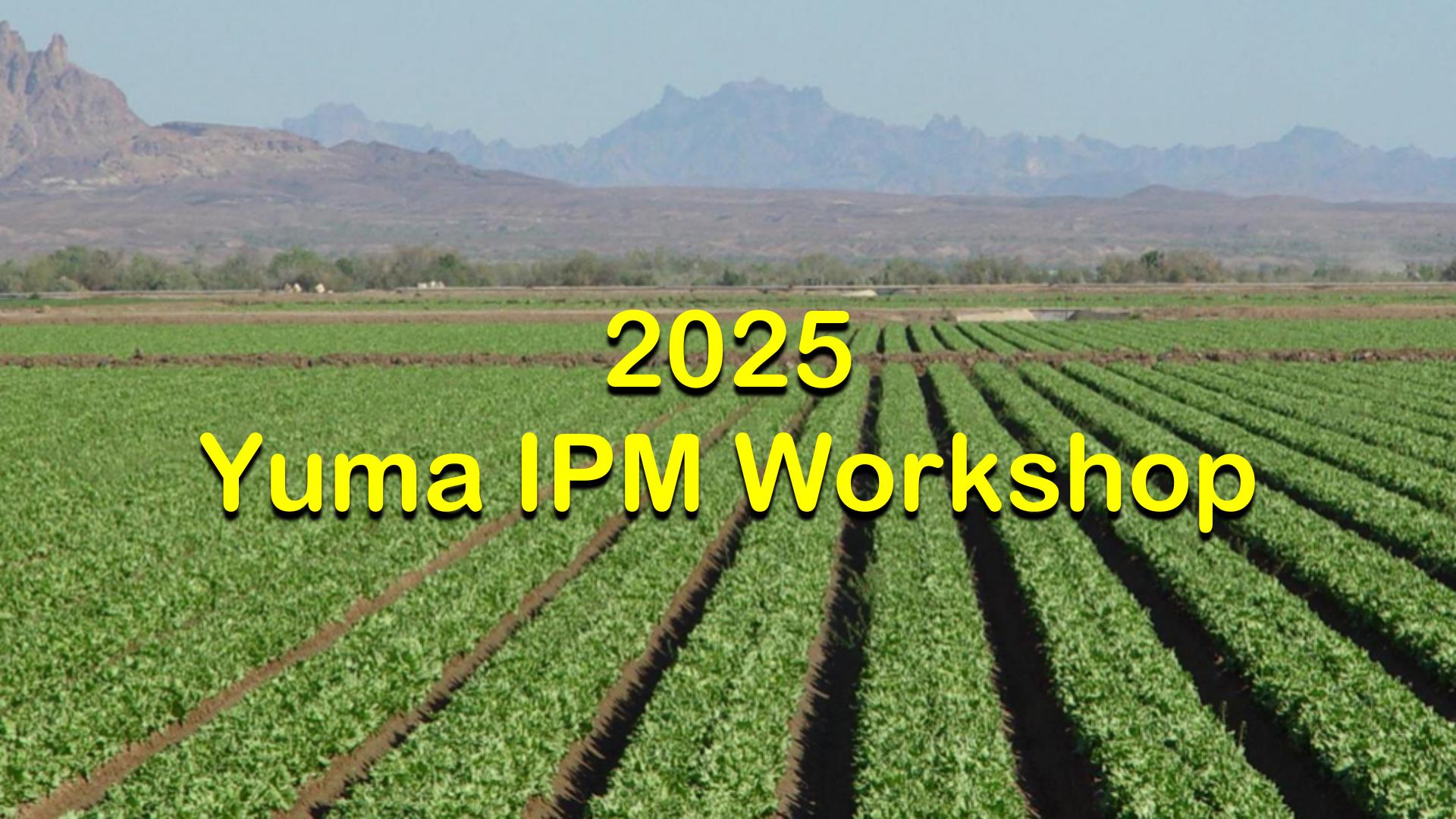
Course Name: 2025 Yuma Fall IPM Workshop
Module 1: Dr. Mazin Saber, Listening to Yuma Growers: Needs Assessment Insights and the Role of Sudan Grass Allelopathy in Crop Rotations, Dr. Stephanie Slinski, Fusarium Wilt Update California and Arizona, Dr. Wilfrid Calvin, Updates on Insecticide Efficacy Trials in Organic Vegetable and Lemon. 42:32
Module 2: Robert Masson, Drones in Agriculture, Macey Keith, Lettuce Pest and Whitefly Management, Dr. Samuel Discua, John Palumbo Vegetable IPM Program 2024-25. 1:05:01
OPTIONAL (No CEU Credits provided for Module #3)
Module 3: Dr. Ali Mohammed, Can Better Irrigation and Nitrogen Management Lower Aphid Pressure?, Dr. Bhupinder Singh, Agronomic and Physiological Response of Broccoli to Irrigation Methods and Soil Amendments, 37:46
Course Number: CA# DPR-0804-26, 2.5 CEU's (Other), AZDA # 26198, 2.5 CEU's, CCA # SS 60813, 2.5 CEU's (IPM)
CEU Credits: This course is accredited by the California Department of Pesticide Regulation, Arizona Department of Agriculture and Certified Crop Adviser.Course availability will be through the end of the year and will be removed December 31st 2024.
The course contains video, requiring a computer that can play audio and video.
Contact and technical support: Robert Masson, masson@arizona.edu
- Teacher: Don Dinwiddie
- Teacher: Robert Masson

Course Overview
The California 4-H New Volunteer Course is a necessary resource for adults starting their first year or coming back after a break of a year or more. In this course, you will learn important parts of 4-H service, like an orientation, CANRA guidelines, and the 4-H Thriving Model for Positive Youth Development. You'll also learn about 2-Deep Supervision and the 4-H program's commitment to creating a safe and welcoming environment for all youth, and how you can help achieve that vision.
Length
1 hour, 35 minutes (Can be completed over multiple sessions)
- 4-H Orientation - 40 minutes
- CANRA for Volunteers - 30 minutes
- 4-H Thriving Model of PYD - 15 minutes
- 2-Deep Supervision Policy - 5 minutes
- University of California 4-H Core Values - 5 minutes
Who Should Attend
California Adult Volunteers who are starting their first year of service or are returning after a break of a year or more.
- Teacher: Zeva Cho
- Teacher: CA 4-H eXtension Tech Support
- Teacher: Scott Mautte
- Teacher: Gemma Miner

Course Overview
The California 4-H Returning Volunteer Course gives you important updates on policies and best practices to keep you up to date. It focuses on CANRA guidelines and the 4-H Thriving Model for Positive Youth Development. You'll also learn about the 4-H program's commitment to creating a safe and welcoming environment for all youth, and how you can help achieve that vision.
Length
55 Minutes (Can be completed over multiple sessions)
- CANRA for Volunteers - 30 minutes
- 4-H Thriving Model of PYD - 15 minutes
- University of California 4-H Core Values - 5 minutes
Who Should Attend
California Adult Volunteers who are starting their second year of service or more with no breaks in service.
- Teacher: Zeva Cho
- Teacher: CA 4-H eXtension Tech Support
- Teacher: Scott Mautte
- Teacher: Gemma Miner

Descripción General del Curso
El curso para voluntarios que regresan del programa 4-H de California le ofrece actualizaciones importantes sobre políticas y mejores prácticas para mantenerlo al día. Se enfoca en los lineamientos de CANRA y en el Modelo 4-H para el Desarrollo Positivo de la Juventud (4-H Thriving Model for Positive Youth Development). También aprenderá sobre el compromiso del programa 4-H de crear un ambiente seguro y acogedor para todos los jóvenes, y cómo usted puede ayudar a lograr esa visión.
Duración
50 minutos (puede completarse en varias sesiones)
- CANRA para voluntarios - 30 minutos
- Modelo próspero de PYD de 4-H - 15 minutos
- Valores fundamentales de 4-H de la Universidad de California - 5 minutos
Quién Debe Asistir
Voluntarios adultos de California que inician su segundo año de servicio o más sin interrupciones en el servicio.
- Teacher: Zeva Cho
- Teacher: CA 4-H eXtension Tech Support
- Teacher: Scott Mautte
- Teacher: Gemma Miner


Descripción General del Curso
El Curso para Nuevos Voluntarios de 4-H de California es un recurso necesario para los adultos que comienzan su primer año o que regresan después de una pausa de un año o más. En este curso, usted aprenderá partes importantes del servicio 4-H, como una orientación, los lineamientos de CANRA y el Modelo 4-H Thriving para el Desarrollo Positivo de la Juventud. También aprenderá sobre la Supervisión 2-Deep y el compromiso del programa 4-H de crear un ambiente seguro y acogedor para todos los jóvenes, y cómo usted puede ayudar a lograr esa visión.
Duración
1 hora, 35 minutos (Puede completarse en varias sesiones)
- Orientación 4-H - 40 minutos
- CANRA para voluntarios - 30 minutos
- 4-H Modelo próspero de PYD - 15 minutos
- 2-Política de Supervisión Profunda - 5 minutos
- Visión e Impacto de California 4-H - 5 minutos
Quién debe asistir
Voluntarios adultos de California que comienzan su primer año de servicio o regresan después de una pausa de un año o más.
- Teacher: Zeva Cho
- Teacher: CA 4-H eXtension Tech Support
- Teacher: Scott Mautte
- Teacher: Gemma Miner
This online recertification course provides one hour of recertification credit for Ohio Agricultural Fertilizer Applicators. Completion of this one hour program in its entirety will be required for all Ohio Agricultural Fertilizer certificate holders who still need credit, regardless of the number of credit hours already obtained.
Deadline for Private Pesticide Applicators and Fertilizer Certificate only: March 31, 2026
Deadline for Commercial Pesticide Applicators: September 30, 2026
Enter the enrollment key below from the CVENT payment confirmation to access this course. No enrollment key? Purchase access to this course by clicking here.
There are NO refunds issued for this course.
Questions: Call OSU Pesticide Safety Education Program at 614-292-4070 or email us at pested@osu.edu
- Teacher: Kate Hornyak
- Teacher: Chrissy Kaminski
- Teacher: Lillian Pascarello
- Teacher: Ohio Pesticide Safety Education
- Teacher: Colleen Souder
This is a required training for WV Farmers' Market Vendors and Farmers' Markets to accept FMNP and WIC benefits. You MUST complete sections 1, 3, and the quiz in order to earn your completion certificate. You must have your completion certificate before you can accept vouchers.
- Teacher: Maggie Blankenship
- Teacher: Leslie Boggess
- Teacher: Karen Cox
This online recertification course is for Ohio Commercial Pesticide Applicators who need 3.5-4 recertification credit hours to recertify.
Enter the enrollment key below from the CVENT payment confirmation to access this course.No enrollment key? Purchase access to this course by clicking here.
There are NO refunds issued for this course.
Questions: Call OSU Pesticide Safety Education Program at 614-292-4070 or email us at pested@osu.edu
OSU PSEP (pested@osu.edu)
- Teacher: Ohio Pesticide Safety Education
This online recertification course is for Ohio Commercial Pesticide Applicators who need 3.5-4 or more recertification credit hours to recertify.
Enter the enrollment key below from the CVENT payment confirmation to access this course. No enrollment key? Purchase access to this course by clicking here.
There are NO refunds issued for this course.
Questions: Call OSU Pesticide Safety Education Program at 614-292-4070 or email us at pested@osu.edu
- Teacher: Ohio Pesticide Safety Education
This online recertification course is for Ohio Commercial Pesticide Applicators who need 4.5 or more recertification credit hours to recertify.
Enter the enrollment key below from the CVENT payment confirmation to access this course. No enrollment key? Purchase access to this course by clicking here.
There are NO refunds issued for this course
Questions: Call OSU Pesticide Safety Education Program at 614-292-4070 or email us at pested@osu.edu
- Teacher: Ohio Pesticide Safety Education

Course Name: AB001-Record Keeping and Cash Flows
This class starts with the basics of building a financial plan, which is keeping track of your income and expenses. This is where we first introduce the financial self-assessment. Students will fill out the assessment to help them gain a better understanding of their own financial well-being, and hopefully give them motivation to go through the entire money management modules. The assessment is retaken in module 7, which allows students to see their progression. 1. Record Keeping 2. Hand versus. Computer Records 3. 5 Basic Steps to Record Keeping 4. Cash Flow Statements 5. Types of Expenses By the end of this class students should have a clear method for how they want to track their expenses and build a cash flow budget. Questions? Email Trent Teegerstrom at tteegers@ag.arizona.edu.
The course contains video so it requires a computer that can play audio and video.
Contact and technical support: Robert Masson, masson@arizona.edu.
- Teacher: Jody Dean
- Teacher: Don Dinwiddie
- Teacher: Robert Masson

Course Name: AB002-Loans and Credit Cards
At this point, this class does not revisit record keeping, but students should remember to keep track of their cash flows, because they will be referring to them in later modules. AB002 addresses interest rates on loans and credit cards. We also introduce the MyFi Assist app, it is a free financial assistant app. MyFi is used extensively through the money management modules. 1. Components of an Interest Rate 2. Credit Score versus Interest Rate 3. MyFi Assist 4. Paying Credit Cards 5. Paying for House Loans 6. Take-Home Message 7. Money Management Module Review 8. Reminder to Keep Track of your Budgeting Exercise The objective of module 2 is to understand the effects of interest rates, as well as managing loans and credit card usage. Questions? Contact Trent Teegerstrom at tteegers@ag.arizona.edu
The course contains video so it requires a computer that can play audio and video.
Contact and technical support: Robert Masson, masson@arizona.edu.
- Teacher: Jody Dean
- Teacher: Don Dinwiddie
- Teacher: Robert Masson

Course Name: AB003-Applying for a Loan-the 5 C's of Borrowing
This class does not revisit the record keeping assignment, but students should remember to keep track of their cash flows. Also try to answer any questions that may come up while they are trying to compile their budget. Cash flows and budgets will be referred to in later modules. This class addresses the factors that lenders take into account when approving loan applications. Understanding what a lender is looking for in a borrower can help potential borrowers increase their chances of being approved for a loan, or obtaining a better interest rate. 1. Qualities Banks and Lenders Look for in a Borrower 2. Sources of Money 3. Terms and Conditions of a Loan 4. Personal Information Required for Loan Application 5. 5 C’s of Borrowing 6. Basis of Loan Approval Students should keep track of their cash flows and budgets; if they have an accurate budget they may find that applying for a loan is not necessary. Instead, they can cut frivolous expenses and save to buy the things they want. If applying for a loan is necessary, they already have an idea of where they stand in the eyes of a lender. Questions? Email Trent Teegerstrom at tteegers@ag.arizona.edu.- Teacher: Jody Dean
- Teacher: Don Dinwiddie
- Teacher: Robert Masson

Course Name: AB004-Credit Reports and Scores
The course contains video so it requires a computer that can play audio and video.
- Teacher: Jody Dean
- Teacher: Don Dinwiddie
- Teacher: Robert Masson

Course Name: AB005-Savings and Budgeting
This class introduces long- and short-term savings plans and goals as well as how to define each of these. This class also uses the MyFi Assist app to help students create a savings plan. Going over the cash flow and budget assignment will help students introduce savings into their budgets if they have not done so already. Their savings plans should include an emergency fund, a long-term goal like retirement, and at least one short-term goal. If students’ budgets seem to be stretched, they can identify areas where they can spend less or find areas where they can earn extra income. 1. Savings Goals 2. Good versus Bad Savings Goals 3. Risk and Rates over Time 4. Where Do I Save my Money? 5. Budget Check-Up and Questions 6. Finding Ways to Save 7. Inflation Questions? Email Trent Teegerstrom at tteegers@ag.arizona.edu.The course contains video so it requires a computer that can play audio and video.
- Teacher: Don Dinwiddie
- Teacher: Robert Masson
Course Name: AB006-Personal Finances
This course is an in-class review of the long-term cash flow and budgeting assignment. A discussion will cover how students developed their cash flows. Did they run into any obstacles? Did they figure out where to put odd expenditures? Are they having problems incorporating savings into their budget? Is their budget accurate? This module helps students understand that they can still reach their goals while meeting their financial needs. 1. Students’ Cash Flow 2. Trade-Offs 3. Wants verus Needs 4. Unexpected Expenses 5. Hold Yourself Accountable 6. Adjust Your Expenditures Questions? Email Trent Teegerstrom at tteegers@ag.arizona.edu.The course contains video so it requires a computer that can play audio and video.
- Teacher: Jody Dean
- Teacher: Don Dinwiddie
- Teacher: Robert Masson
Course Name: AB007-Creating Your Financial Plan
The focus of this course is to help students analyze their budgeting assignments. Students will identify their goals and insert them into their budgets. This is also a point to reiterate trade-offs and wants versus needs (refer to module 6) to help keep a balanced working budget. Included in this module is the financial self-assessment worksheet that was initially provided in module 1 in addition to a budget review questionnaire. Students fill out the financial self-assessment worksheet. The self-assessment worksheet will give them a benchmark for their progress, as well as a direction for what they need to be working on. 1. Length of time to maintain records 2. Review progress on exercises 3. Creating your plan 4. Assessment of current situation 5. Analyze your assessment 6. Prioritize your goals 7. Develop a plan to achieve your goals 8. Review your plan 9. Monitor and modify your financial plan Questions? Email Trent Teegerstrom at tteegers@ag.arizona.edu.The course contains video so it requires a computer that can play audio and video.
- Teacher: Jody Dean
- Teacher: Don Dinwiddie
- Teacher: Robert Masson
Course Name: AB009-Early Development of a new Idea
This course uses a mini assessment tool to help a prospective entrepreneur determine whether they are financially and personally capable of starting a new venture. Once the mini assessment is complete, another set of questions goes into more detail about the product, cost structure, and market. The more detail a prospective entrepreneur can put into the answers, the better prepared to start a business they are. The business planning questions are meant to give participants a comprehensive look at the steps to starting a business. 1. Am I ready to start a business? 2. Introduction to finances and budgeting 3. Developing a market strategy 4. Can I make money? Questions? Contact Trent Teegerstrom at tteegers@ag.arizona.edu.The course contains video so it requires a computer that can play audio and video.
- Teacher: Jody Dean
- Teacher: Don Dinwiddie
- Teacher: Robert Masson
Course Name: AB010-Market Assessment-Estimating Market Size and Price
This course is a comprehensive look at defining a customer base, estimating the size of the market, and determining a price point. This class uses worksheets to guide participants through the process of determining market size and price points for their products. Each worksheet covers a different topic, including customer segmentation, potential volume, competition, pricing strategy, and promotion strategy. Additional resources are listed in the PowerPoint presentation to help participants find information on potential customer demographics, average food consumption, and pricing. Completing a market assessment is an important and cost-effective step in starting a business: Investing time into completing one now can save money in the future. 1. Market assessment process 2. Estimating product price 3. Competitive analysis 4. External factors in pricing Questions? Contact Trent Teegerstrom at tteegers@ag.arizona.edu.The course contains video so it requires a computer that can play audio and video.
- Teacher: Jody Dean
- Teacher: Don Dinwiddie
- Teacher: Robert Masson
Course Name: AB011-Introduction to Budgets and Financial Statements
This course is meant to be an introduction to (not a comprehensive understanding of) different types of financial statements and budgets (budgets will be covered in greater detail in AB012). Understanding financial statements can benefit business owners by helping them determine whether or not the business or enterprise is performing as expected. When discussing budgets, help participants understand that budgets are a way of managing resources to maximize profits. The budgeting worksheets used in this module are meant to guide participants through the steps of building their own enterprise budgets and incorporating all production costs. Future entrepreneurs should be as accurate as possible with their revenue and expenses, and understand that it is easier to make adjustments on paper now, rather than when their businesses are operational. The cash flow worksheets help visualize when expenses are incurred and when revenue is generated. The excel version of the worksheet can be a helpful tool to use as an in-class example, and the long-term cash flow worksheet can help your participants compare different cash flow scenarios and see whether they will run a deficit or a surplus. 1. Types of budgets 2. Cash flows 3. Types of financial statements 4. Important ratios 5. Why it is important to keep records Questions? Contact Trent Teegerstrom at tteegers@ag.arizona.edu.The course contains video so it requires a computer that can play audio and video.
- Teacher: Jody Dean
- Teacher: Don Dinwiddie
- Teacher: Robert Masson
Course Name: AB012-Financial Analysis
This course builds on the previous module’s financial overview of budgets and statements. Using examples, this class explains in greater detail how to create and analyze a partial budget and an enterprise budget using tools like sensitivity analysis and break-even analyses. MyFi Assist is also re-introduced. This tool can be used to find monthly payments to be used in a partial budget or an enterprise budget, which will allow participants to find break-even points or complete sensitivity analyses. Participants should understand that all financial options should be considered on paper to determine the outcomes that are good, bad, and ugly. Once these are known, it becomes possible to plan for future financial success. 1. Sensitivity analysis 2. Break-even analysis 3. Partial budgeting Questions? Email Trent Teegerstrom at tteegers@ag.arizona.edu.The course contains video so it requires a computer that can play audio and video.
- Teacher: Jody Dean
- Teacher: Don Dinwiddie
- Teacher: Robert Masson

Course Name: AB013-Introduction to American Indian Land Tenure Act
This course covers first how American Indian reservations were established, beginning with the Doctrine of Discovery, to Manifest Destiny and the creation of the Office of Indian Affairs, through the evolution of federal policies that have created the reservations that we know today. The second section of the module covers the difficulties of navigating the uniqueness of each reservation. How the reservation was established and whether or not it was impacted by the Dawes Act of 1887 will determine land tenure on a given reservation. American Indian trust land is held in a "trust status" by the US government; in the case of allotments, fractionation occurs, resulting in hundreds of owners on a single parcel of land. Water rights are also brought up as a contentious issue on reservations, and the use of Indian trust land as collateral is difficult. This class shines light on the laws and legislation that have created social economic hardship for reservations and Native Americans. 1. Federal policy eras 2. Tribal governance and the federal relationship 3. Tribal sovereignty 4. General Allotment Act, 1887 5. Fractionation 6. Trust to fee conversion 7. Water rights on reservations Questions? Email Trent Teegerstrom at tteegers@ag.arizona.edu.The course contains video so it requires a computer that can play audio and video.
- Teacher: Jody Dean
- Teacher: Don Dinwiddie
- Teacher: Robert Masson